Three Good Years. One Bad Month. What Most Risk Models Miss.

Market volatility has returned, and for many advisors, so has the realization that standard risk tools weren’t built for the moments that matter most. With recent geopolitical shocks moving markets faster than legacy risk models can respond, this article examines why traditional risk metrics fall short during periods of extreme stress, how tail risk modeling—the framework risk theorist Nassim Taleb has called essential for understanding fat-tail events—can provide additional perspective on portfolio behavior, and what RIA firms can do now to strengthen client relationships, reduce reactive decision-making, and build a more resilient practice before the next drawdown makes the conversation harder.
Key Takeaways:
- Firms that make risk a continuous part of client conversations may be better equipped to support client relationships during periods of volatility.
- Traditional risk metrics like standard deviation often miss extreme market events, the moments that most damage client trust.
- Tail risk modeling captures how portfolios behave under stress, including during geopolitical shocks and fat-tail events that Nassim Taleb and others have shown are systematically underweighted by standard models.
- Investors feel the pain of losses far more acutely than the pleasure of equivalent gains, as documented by Kahneman and Tversky, making ongoing risk communication essential.
- Risk tools are most effective when embedded in daily advisor workflows, not accessed as a periodic exercise.
Risk conversations just got real again
Over the past three years risk conversations quietly moved to the background. Risk didn’t disappear. The market just didn’t force most investors to confront it. Markets delivered a rare stretch of consistency: strong returns, low friction, and fewer reasons for clients to question what they owned or why they owned it. For many advisors, that meant fewer difficult conversations. Portfolios performed. Clients felt content. Risk tolerance, once carefully defined, became something assumed rather than revisited.
Now volatility is back, and so are the questions.
And increasingly, those questions aren’t just being driven by market cycles—but by real-world events that can move markets quickly and unpredictably, like the conflict in Iran. This geopolitical development is a reminder of how quickly risk can move from background noise to front-page reality. As Nassim Taleb, best-selling author of The Black Swan, has argued, wars and systemic shocks are classic fat-tail risks, events that don’t follow average patterns and can rapidly cascade across markets. These are precisely the scenarios where traditional risk models fail to provide adequate insight.
The complacency trap: what three good years did to risk conversations
Bull markets tend to push risk management conversations to the back burner because nothing concerning triggers a conversation.
Complacency builds. Not due to neglect, but through reinforcement. When portfolios are performing and clients feel comfortable, there’s no natural trigger to revisit assumptions. Risk tolerance has already been defined and documented within the firm’s risk management framework, and quietly set aside while markets move on.
This is status quo bias at work. When outcomes are positive, both advisors and clients are incentivized to stay the course, not just in portfolios, but in the conversations surrounding them.
Until the moment it matters.
Decades of behavioral finance research, rooted in Kahneman and Tversky’s foundational Prospect Theory (Econometrica, 1979), consistently show that investors feel the pain of losses far more acutely than the pleasure of equivalent gains, a pattern that plays out in client behavior when markets turn volatile.
The core problem: standard risk metrics fall short
Most advisors measure risk the way the industry taught them to.
Modern portfolio theory (MPT) relies on formulas—standard deviation, Sharpe ratio, volatility bands—that brought structure and consistency to portfolio construction. At the time, they were a meaningful step forward. They made risk quantifiable, comparable, and easier to communicate.
But they were also a product of their time.
As Amplify Chief Technology Officer David Hatfield explained on a recent episode of the Zephyr Adjusted Risk podcast, “Many of these measures were developed in an environment where computational power was limited. Simpler models, focused on averages and distributions, were not just preferred, they were necessary. And for decades, those models have remained the industry standard.”
Why do traditional risk models fail during market volatility?
Standard deviation, one of the most common risk management measurement models, smooths outcomes across time. It blends good months and bad months into a single number—a view of risk that is mathematically consistent but often disconnected from how investors actually experience it.
“MPT is really good at smoothing out and saying, what’s my average loss or what’s my average kind of behavior? Tail risk takes a little bit different approach where it says, when things get bad, this is how bad they get,” Hatfield said.
This is where traditional risk models used in wealth management begin to fall short. Risk formulas built for typical market conditions can underrepresent extreme outcomes, the very periods that tend to most impact clients, driving client reactions and decision-making. As Hatfield explains, “Where standard deviation can hide those really bad months, tail risk highlights how bad it can get.”
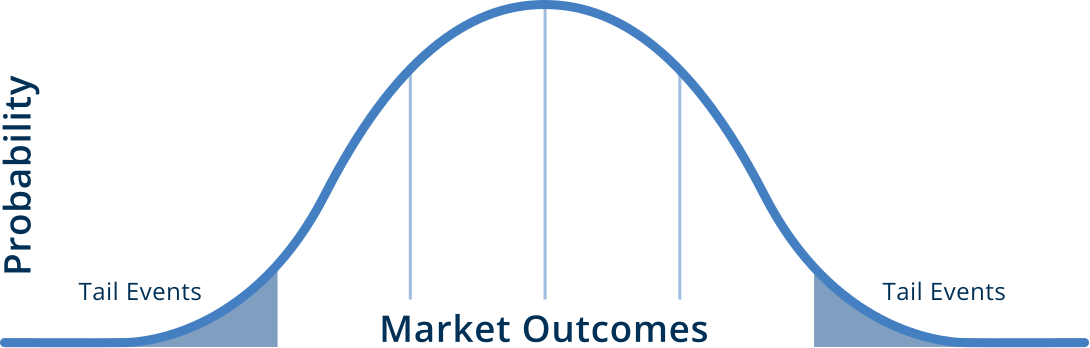
That distinction matters. Client trust is most often shaped during periods of market volatility, not when markets behave as expected.
It’s also worth noting that traditional models rely on assumptions that can break down precisely when they’re needed most. In normal markets, assets may appear well-diversified. In stressed markets, correlations shift quickly. This played out in 2022 when the inflation rate hit 8% annually and the assumed inverse relationship between stocks and bonds failed to hold.
Related Blog: If you’re still talking about risk the old way, prepare to be left behind.
The opportunity for RIA firms: volatility as a catalyst for growth, not a crisis
Market volatility has a way of forcing conversations that should have happened earlier. It also exposes how risk is operationalized across the advisory firm.
After extended periods of market stability, many firms find that their approach to portfolio risk management is episodic—defined at onboarding, revisited periodically, and largely disconnected from day-to-day decision-making. That model holds up when markets are cooperative. It becomes more fragile when they’re not.
For RIA leaders, this latest round of volatility raises a more fundamental question: is the risk framework they’re using built for the moments that matter most? When portfolios behave in ways clients didn’t expect or prepare for, the impact extends beyond performance. It affects confidence, decision-making, and retention.
At the firm level, that shows up in ways that are harder to measure but more consequential—clients questioning strategy, increased service burden during periods of stress, reduced referral activity at the exact moment growth should accelerate, and pressure on long-term AUM stability and enterprise value.
As Hatfield put it, “If your tool for calculating risk is sitting off to the side and you never go and visit it again, that’s probably the worst risk tool that you could have because you’re not using it.”
Tail risk modeling: a more complete view of portfolio risk
Instead of relying on average outcomes or simplified assumptions, tail risk models consider how portfolios behave across a wide range of market scenarios, including extreme events, capturing both the likelihood and severity of potential losses.
This provides a more realistic view of portfolio risk in real-world market conditions, one that reflects how markets actually behave during periods of stress rather than how they’re assumed to behave under ideal conditions. For firms, it moves risk from a static estimate to a forward-looking view of how portfolios may behave when conditions deteriorate and where vulnerabilities may exist before they’re exposed.
When risk is understood in terms of real-world outcomes, firms are better positioned to construct portfolios that align more closely with client expectations, prepare clients for how those portfolios will behave in difficult markets, and reduce the likelihood of reactive decisions that undermine long-term outcomes.
When these elements are aligned, the benefits extend beyond performance, showing up in client confidence, retention, referrals, and ultimately the firm’s ability to scale and sustain enterprise value over time.
Making risk management a daily practice, not a periodic exercise
As Hatfield noted during the podcast, “If a risk tool requires an extra step to access, it’s unlikely to shape decisions when it matters most.” An alternate approach is to use a tool that monitors risk continuously in real time, keeps it visible across portfolios, models, and client accounts, and is responsive to changes as they happen.
That shift is now possible. Thanks to advances in high-performance computing and graphics processing along with extensive research in fat tail risk modeling, Amplify’s QuantumRiskTM risk tool calculates risk in real time. Embedded directly into the Amplify platform, QuantumRiskTM makes it easy for advisors to measure, calculate, and manage portfolio risk across the firm.
RIA Risk Management FAQs
What is tail risk in portfolio management?
Tail risk refers to the potential for extreme portfolio outcomes during extreme market events, something traditional risk models (bell curves and standard deviation) tend to miss. Unlike traditional risk models, tail risk modeling focuses on how severe losses can be and how frequently they may occur under stressed conditions.
What happens to portfolios during unexpected geopolitical events?
Unexpected geopolitical events, such as a military conflict or drastic policy changes, are classic “fat-tail” risks. These events can trigger rapid, nonlinear market reactions where correlations no longer apply and multiple assets decline simultaneously, something traditional risk models that rely on averages often fail to capture.
Why is standard deviation not enough to measure risk?
Traditional portfolio risk models based on standard deviation use normal distribution as the main statistical pillar and look backward when calculating risk. In reality, markets experience periods of extreme volatility more often than these models predict, which can lead to underestimating real-world risk.
How can RIAs better prepare clients for market downturns and volatility?
Firms can prepare clients by modeling downside scenarios, setting clear expectations about potential drawdowns, and making risk a continuous part of client communications—not just an occasional assessment.
Amplify Technology, LLC (“Amplify”) is not a registered investment adviser. Its services are for informational purposes only
and do not constitute investment advice or recommendation. Please consult a registered investment adviser before using Amplify and its services.
QuantumRisk™ is a proprietary tool developed by Amplify Technology, LLC. It is for informational and educational purposes only, designed to support financial professionals in evaluating portfolio risk. It is not investment advice and does not make recommendations to buy or sell any security. Outcomes will vary depending on advisor use and client circumstances.

Contact Us
Have a question?
To learn more about the Amplify Platform and how Amplify can simplify your journey with modern technology that works for you, reach out to connect with our experts today.