Digital Onboarding for RIAs: 5 Questions Every Firm Should Ask

Digital account opening is only one stage of RIA client onboarding. Amplify CMO Jack Martin explains why onboarding capacity can constrain growth, how household architecture affects the process from creation through funding and beyond, and five questions RIAs can use to evaluate digital onboarding platforms.
Key Takeaways
- Account opening is one stage of digital onboarding. Custodians have made significant progress digitizing their part of the process, but client onboarding spans the journey from household creation through funding and into downstream workflows.
- Onboarding capacity can constrain RIA growth. As firms add clients, teams, and accounts, manual handoffs and reconciliation can translate directly into additional operational headcount.
- Household architecture matters. Defining the household and related entities at the transactional layer gives client data a consistent structure and a unified household record that can carry across onboarding, investing, billing, reporting, and servicing.
- A platform demo should expose where manual work re-enters the process. RIAs should test real-world complexity—including multiple accounts and custodians—and watch what happens to the household and its data from creation through funding and beyond.
- Owning the household record simplifies change. When the firm adds a custodian, the record already holds what the new paperwork needs, with no need to re-ask the client or re-sync a CRM.
I ran an RIA for three decades before I moved to the technology side. Every 40 to 50 new households added to the firm also meant adding another ops hire. That felt like the normal cost of growth.
More clients meant more paperwork to prepare, more accounts and transfers to track, more data moving between systems, and more work for someone on the team to handle to keep the client onboarding process moving.
A lot has changed since then. Custodians have made tremendous progress digitizing account opening, making their part of the onboarding process faster and easier for firms and their clients. Schwab, for example, reports that its digital account opening tool allows advisors to open, fund, and set up multiple account types in minutes.
Yet 72% of firms still rank onboarding as a top source of friction, more than any other process (F2 Strategy). Clearly, the problem is bigger than account opening; custodians have solved for that. What they haven’t solved is everything before and after it.
Onboarding capacity can become a constraint on growth
Onboarding doesn’t end when the forms are signed or even when the accounts are opened. The process should carry the household from creation through funding without repeated data entry or manual reconciliation. Once funded, that same household structure should carry forward into investment management, reporting, billing, and other downstream workflows.
That becomes increasingly important as a firm grows. Adding a new client, a breakaway team, or a block of new accounts creates onboarding work before it creates revenue. The more business a firm needs to absorb, the more its onboarding capacity can determine how quickly new AUM becomes invested AUM.
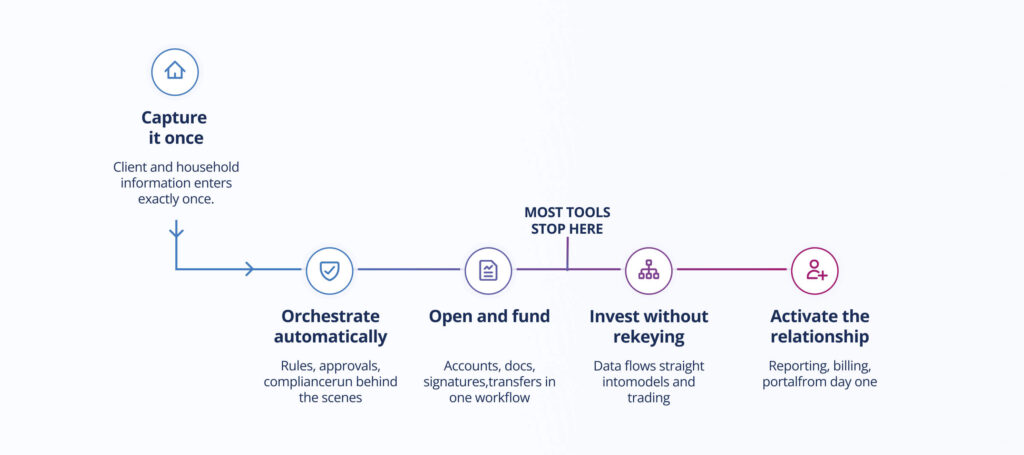
The architectural test platform vendors need to pass for digital onboarding to work
A successful digital onboarding experience hinges on one key step, and it happens before a single client is onboarded. The platform must have defined what a household means at the transactional layer, along with every core business entity related to it.
When that definition is established at the platform level, the client information entered during onboarding has one place to go. That definition also provides the structure for creating the household during onboarding, so any accounts opened for that client can be managed collectively, with every system downstream reading from the same source of truth.
Advisors and ops teams don’t need to reconcile competing definitions for the same household. Skip that step, and conflicting definitions from multiple systems remain, and reconciliation never ends.
Simply integrating systems doesn’t fix the problem either. Systems that disagree on how a household is defined will still disagree once they’re integrated. They’ll just disagree faster.
The test for platform vendors is whether they define household and related entities once, at the transactional layer of the platform, or whether human middleware will need to reconcile conflicting definitions later. The five questions below reveal which path the vendor took.
Five questions RIAs should ask platform vendors about digital onboarding
The steps a platform actually executes during onboarding aren’t always obvious in a platform demo. These questions can help you determine how the platform establishes and carries the household forward, where manual work enters the process, and what happens to the client data along the way.
One rule to keep in mind: request a demo, don’t settle for a description. Ask the vendor to use a household that’s similar to the ones in your book (e.g., more than one account, more than one custodian, at least one complexity), then watch what happens when things get complicated.
1. Does the household record created during onboarding drive billing and performance reporting, or are those set up separately?
That’s the same entity entered two additional times, and it’s common enough that most firms stop noticing. If billing households are configured independently, someone maintains the relationship between the different versions permanently. At scale, duplicate setup becomes another operational dependency the firm has to staff and maintain as it grows.
Strong answer: one unified household record, created once, that billing, reporting, the client portal, and other downstream workflows all inherit without separate configuration.
The tell: most vendors will answer “fully integrated.” Ask instead who sets up the billing for the household and on which screen. If that’s an operations step after the household information is initially entered, it’s the same data entered twice.
2. During implementation, will we have to decide which vendor is authoritative for each core entity?
This exercise is common when a firm’s stack is built with multiple vendors, each with its own system of record. When the same core entity exists in more than one system, the firm has to decide which version is authoritative. This issue exists because the definitions underneath the platform were never standardized, so someone has to arbitrate them. That arbitration is the price of fragmentation, and the firm keeps paying it long after implementation ends.
Strong answer: no arbitration required, because the platform’s unified record holds one definition of each core entity and every application reads from it. Implementation configures the firm’s own business rules inside that model.
The tell: the answer arrives as a positive. This question gets answered honestly, because a mapping workshop is presented as a best practice. Listen for “system of record,” “data authority,” or “field-level ownership” in the implementation plan.
3. After the client signs, how far does the account get before someone has to re-enter data?
Many client onboarding solutions can submit paperwork to the custodian for account opening and initiate transfers. The better test is how far the client data travels from there without being entered again.
Strong answer: the account is opened at the custodian and funded, and the household data flows into portfolio construction, models, trading, and servicing without re-entry, ready to trade as soon as the advisor is.
The tell: “seamless, end-to-end.” Ask what the advisor does next, specifically, and whether any client or household data has to be entered again. If someone has to re-key information, that’s a handoff.
4. When something changes in the household, how many systems have to be updated?
Investing, trading, billing, reporting, and the client portal each run their own workflow. What matters is where they all read from. Onboarding is where the household record gets created, and the years that follow show whether it holds. A new address, an updated beneficiary, or a fee change either happens once or gets repeated in every system that keeps its own copy.
Strong answer: the change is made once, on the household record, and every downstream workflow reads the update.
The tell: the vendor describes syncing between modules or a scheduled update between systems. Ask how many systems the ops team has to touch to make one change. One change should carry everywhere. If ops has to update more than one system, the record isn’t unified, and reconciliation will be ongoing.
5. When our firm adds a custodian, does the platform use the household record we already have, or create a new one?
Most demos show a household being built from scratch. Real books add custodians over time, whether through a repaper, a breakaway team bringing its relationships, or a custodian changing its terms. By then the firm already knows the household: the accounts, the names, the Social Security numbers, the beneficiaries. The question is whether the platform can use what’s already there.
Strong answer: nothing changes about the existing household record. The firm selects the new custodian’s forms, the client’s information is already in place, and a custodian change becomes a repapering. Nobody re-asks the client, checks the CRM, or rebuilds the household.
The tell: the answer is about custodian count or about syncing the CRM to the new custodian. If the answer is “create a new one,” the firm doesn’t own the household record. And whoever owns the record orchestrates the economics.
What the answers are worth
Five questions won’t tell a firm which platform to buy. They will reveal how much of the onboarding journey the platform actually handles, where manual work enters the process, and whether the household created at the beginning remains intact as a unified household record through funding and beyond.
That household record should become the foundation for how a firm invests, bills, reports, and serves the client for years. The less it has to be recreated, reconciled, or manually moved from one system to another, the more new households and assets the firm can absorb without adding headcount at the same rate.
Jack Martin, a former RIA founder, currently serves as Chief Marketing Officer for Amplify Platform.
Digital Onboarding FAQs
How does digital onboarding integrate with a firm’s CRM?
CRM integrations vary by platform. Some allow existing client data to populate the onboarding workflow, while others support data moving in both directions or syncing selected fields between systems. RIAs should understand what data moves, in which direction, when it updates, and whether any information has to be re-entered or reconciled manually.
What compliance benefits come from digital onboarding?
Digital onboarding can help RIAs standardize how client information and required documents are collected, reduce missing or incomplete information, and create a documented record of what was provided and signed. Depending on the platform, it may also provide validation controls, timestamps, review and approval workflows, and easier access to records for supervision or audits. Firms should evaluate these capabilities against their own compliance requirements and supervisory procedures.
What is the difference between digital account opening and digital onboarding?
Digital account opening is one stage of the broader onboarding process. The custodian opens the account after receiving the required application and paperwork. Digital onboarding begins earlier with household creation and can include custodian applications, suitability and KYC, firm paperwork, review and approval, and signing. On Amplify, it continues through account opening and funding, with the household and its data carrying forward into investment management, trading, billing, reporting, and the client portal.

Contact Us
Have a question?
To learn more about the Amplify Platform and how Amplify can simplify your journey with modern technology that works for you, reach out to connect with our experts today.