The RIA Leaders’ Field Guide to Data and AI

Data lake. Clean data. AI-ready. Connected systems. These terms appear in every pitch and every board deck, yet few RIA leaders can define them with confidence. This field guide, drawn from a working conversation with Amplify CTO David Hatfield, CPO Churni Bhattacharya, and Managing Director of Enterprise Strategy Adam Scully-Power, defines the concepts that now decide how efficiently your firm runs, how safely it can adopt AI, and what it is ultimately worth. It closes with a plain-language glossary, a one-page diagnostic for your firm, and six questions to put to any provider, including us.
Key Takeaways
- Clean data means one agreed, accurate version of each fact, defined the same way everywhere it appears. Connected data means one shared, persistent record, not a long list of integrations.
- A data lake is only as valuable as the discipline applied to data on the way in. The medallion architecture (bronze, silver, gold) describes how raw data becomes trustworthy.
- You should own your raw data without question. Get it in writing who owns the analytics and AI outputs built on top of it, because portability affects what your firm is worth.
- Fragmentation is an architecture problem, not a technology problem. Buying more tools usually raises the integration tax.
- In Schwab’s RIA Benchmarking Study, Top Performing Firms spent about 25% less time per client on operations, saw twice the revenue growth, and attracted 85% more new clients than other firms.
- AI inherits the quality of the data underneath it, at speed. Foundation first, then AI on
top.
Why this guide exists: the vocabulary problem
Wealth management is in the middle of a vocabulary problem. The terms are everywhere now, and very few of the people being asked to act on them can define them with confidence. That gap is not a failure of intelligence. It is the predictable result of an industry being asked to make foundational decisions faster than it has been given the language to evaluate them.
This guide is meant to close that gap. It is a plain-language reference, written for the operator rather than the engineer. We take one idea at a time, separate the durable concepts from the marketing, and give you language you can carry into your next leadership meeting. We do get to AI. We get to it last, on purpose, because by the time we arrive the reason it matters will be obvious. If this guide helps you ask sharper questions of every provider you evaluate, including us, it has done its job.
A note on how to use it. The six sections build in sequence and read in one sitting. The back of the guide is a reference layer: a plain-language glossary, a short AI vocabulary, a one-page diagnostic for your own firm, and the exact questions to put to any provider. Read the body once. Keep the reference section. Share both with anyone at your firm who touches technology, operations, or strategy.
1. What “clean, connected data” actually means
Two words get attached to almost every platform in this industry. Both are usually undefined. Start here, because nearly everything later depends on getting these two right.
Every vendor says their data is “clean.” What does that actually mean, and how would I know if mine isn’t?
Clean data means there is one agreed, accurate version of each fact, defined the same way everywhere it appears.
In most firms, the same client, household, or account lives in several systems at once, and those systems often disagree. One defines a household one way, another splits it differently. One holds a current address, another an old one. Each version is internally plausible, which is exactly what makes the disagreement dangerous: you have several versions of the truth and no automatic way to know which is right.
Clean data is the result of resolving those conflicts into a single authoritative record, with consistent definitions for the core entities every firm runs on: client, household, account, position. Not “mostly aligned.” Defined once and used everywhere.
Why this matters for your firm. You cannot reason reliably about a client, and you certainly cannot let AI reason about them, if your own systems quietly disagree about who that client is and what they hold.
What does “connected” data mean, and why does everyone brag about how many integrations they have?
Connected data means information flows continuously and completely as one shared record, rather than being passed in fragments between separate systems.
The integration count is largely a vanity metric. “We connect to fifty tools” tells you nothing about what those connections actually do. Most integrations are point-to-point: two systems exchanging a few specific fields on request, often partial by design. The question worth asking is not how many integrations exist, but whether they produce a single, unified workflow or simply a larger pile of loosely linked tools.
Connected data, properly understood, is persistent rather than point-to-point. The information is not re-fetched and re-stitched for every task. It lives in one place, in one shape, and every function reads from and writes to it.
Why this matters for your firm. A long list of integrations can coexist with a deeply disconnected firm. Ask what the connection delivers, not how many there are.
Related reading: Multi-Custodian Challenges Won’t Go Away Until We Stop Solving the Wrong Problem
People throw around “structured,” “unstructured,” and “metadata.” What do those mean?
They describe the kinds of information your firm holds, and how easily a machine can work with each.
- Structured data is information that already lives in neat rows and columns: account balances, transaction amounts, security identifiers, demographic fields. It is easy to sort, filter, and compute on. Most of what sits inside your portfolio and billing systems is structured.
- Unstructured data has no predefined shape: meeting notes, emails, PDFs, call transcripts, planning narratives. It is harder for a system to read, yet it holds some of the richest signals about what a client actually wants. This is precisely the territory where AI creates new capability, because it can read unstructured material that older systems could only store.
- Metadata is data about data: when a record was created, who created it, which system it came from, how it has changed. It is unglamorous and it is what makes information searchable, traceable, and defensible. When compliance needs to show the provenance of a decision, metadata is what they reach for. Strong metadata habits are a quiet marker of a serious data operation.
2. Data lakes, ownership, and how raw data becomes trustworthy
Once “clean” and “connected” are clear, the next phrase you will be sold is the data lake. Here is what it is, when you actually need one, and how to tell a genuine asset from an expensive liability.
I’ve been told we need to build a data lake. What is it, and do we actually need one?
A data lake is a separate store designed for analysis and history, distinct from the day-to-day systems your team works in. Whether you need one depends entirely on what you want it to do.
Your transactional systems, the applications where work actually happens, are built to move data in and out quickly. They are generally not built to remember. A data lake is the opposite: it is optimized to hold large volumes of information over time, including history, so the data can be examined, compared, and used to drive insight and AI.
But “build a data lake” is not a goal. It is a means. The first question a technology provider should ask you in return is: a lake for what? What decision are you trying to make that you cannot today? A lake with no clear purpose is just a large, expensive holding tank.
Why this matters for your firm. Start from the insight you want, then work backward to the foundation. A lake assembled without that clarity tends to become a cost center rather than an advantage.
A provider offered to build a data lake for us. How do I know I’m getting a lake and not a swamp?
The difference between a lake and a swamp is not the volume of data. It is whether the data has been cleaned, conformed, and made trustworthy on its way in.
It is entirely possible to gather an enormous amount of data into one place and end up worse off. If what flows in is inconsistent, duplicated, or undefined, you have not built a resource. You have built a swamp: a great deal of water, none of it safe to drink.
What makes it a lake is the transformation the data goes through on the way in. That progression, from raw to conformed to business-ready, is what earns the trust. Ask any provider to walk you through exactly how raw inputs become trustworthy outputs. If they cannot, you are most likely buying a swamp.
Why this matters for your firm. The value is not in the storage. It is in the discipline applied to the data before it ever lands there.
Someone mentioned “bronze, silver, gold.” Can you explain that in plain language?
It is the standard industry name (the “medallion” architecture) for the three stages data passes through on its way from raw to trustworthy.
Bronze is the raw landing zone: data copied out of your working systems exactly as it is, inconsistencies and all. Silver is where it becomes trustworthy: conflicts resolved, duplicates merged, one consistent record. When people say “clean data,” the silver layer is largely what they mean. Gold is business-ready and AI-ready: the conformed data reshaped for a specific purpose.

The journey from raw to trustworthy. “Clean data” is the silver layer.
In practice, governing at the source looks unglamorous. When a new account is created, the system will not let it be saved until it is attached to one defined household and one defined client, with a single definition of each position. A second, conflicting version never enters the books, because the system will not accept one.
Why this matters for your firm. A platform that must do heavy cleaning between bronze and silver was not governed at the source. One where bronze and silver look nearly identical was.
Listen: CTO David Hatfield and co-founder Aaron Brodt discuss medallion architecture and why most data lakes are really swamps on Wealth Tech Today, Episode 332.
If a platform holds my data, do I actually own it? And why would that matter?
You should own your raw data without question. The more important and less obvious question is who owns the intelligence built on top of it, and whether you can take it with you.
The raw information you provide, your books and records, is yours, and that is not seriously in dispute. The cleaned, conformed version of that data should also be available to you in a usable form. Where it gets genuinely nuanced is the insight layer: the analytics, scoring, and AI-ready structures a platform builds on top of your data, often shaped specifically for that platform’s own applications.
This is not a reason for alarm. It is a reason to ask precisely. Get specific, in writing, about what you can export, in what form, and what happens to derived analytics and AI outputs if you ever leave. As Section 4 shows, this is not a technical footnote: it can move the value of your firm in a transaction.
Why this matters for your firm. Data portability is not a contractual detail to skim. It determines how much of your firm’s value is actually yours to keep, and to sell.
3. An architecture problem, not a technology problem
This is the reframe the whole guide turns on. Once you see it, you cannot unsee it, and you will evaluate every vendor differently.
Isn’t this just about buying better software? Why do you keep calling it an architecture problem?
Because no individual tool, however good, can fix a foundation. Tools sit on top of the foundation. They cannot replace it.
Most firms approach technology as a shopping exercise: a CRM tool, a performance tool, a trading tool, each chosen on its own merits. That is a technology mindset, and it made sense when technology was the binding constraint. It no longer is. The binding constraint now is whether all of those tools share one clean, connected, owned data foundation underneath them.
A technology problem is “I need a better tool for this task,” and you solve it by buying one. An architecture problem is “my tools do not share a common foundation, so nothing flows,” and no purchase solves it. These load-bearing tools end up carrying weight the foundation should have carried, and they become fragile precisely because they were never meant to.

The layers that actually matter: experience on top, tools in the middle, one owned data foundation underneath.
Why this matters for your firm. If the real problem is architecture, buying more technology does not fix it. It usually raises the integration tax.
People keep talking about “seams” and an “integration tax.” What breaks at the seams, and what is the tax?
These seams are the gaps between systems that were never designed to work as one. The integration tax is the ongoing cost, in people, time, and risk, of holding those seams together.
When tools do not share a common data foundation, something has to bridge them. In most firms, that something is people: teams re-keying information from one system into another, reconciling figures that should already agree, and carrying a client’s context across the gaps by hand. This is the human middleware that quietly runs underneath many advisory firms.
That work is the integration tax. It never appears as a line item, but you pay it every day, in capacity that never reaches a client, in errors at each hand-off, and in workflows that break whenever one tool changes. The more tools you bolt across the seams, the higher the tax climbs.
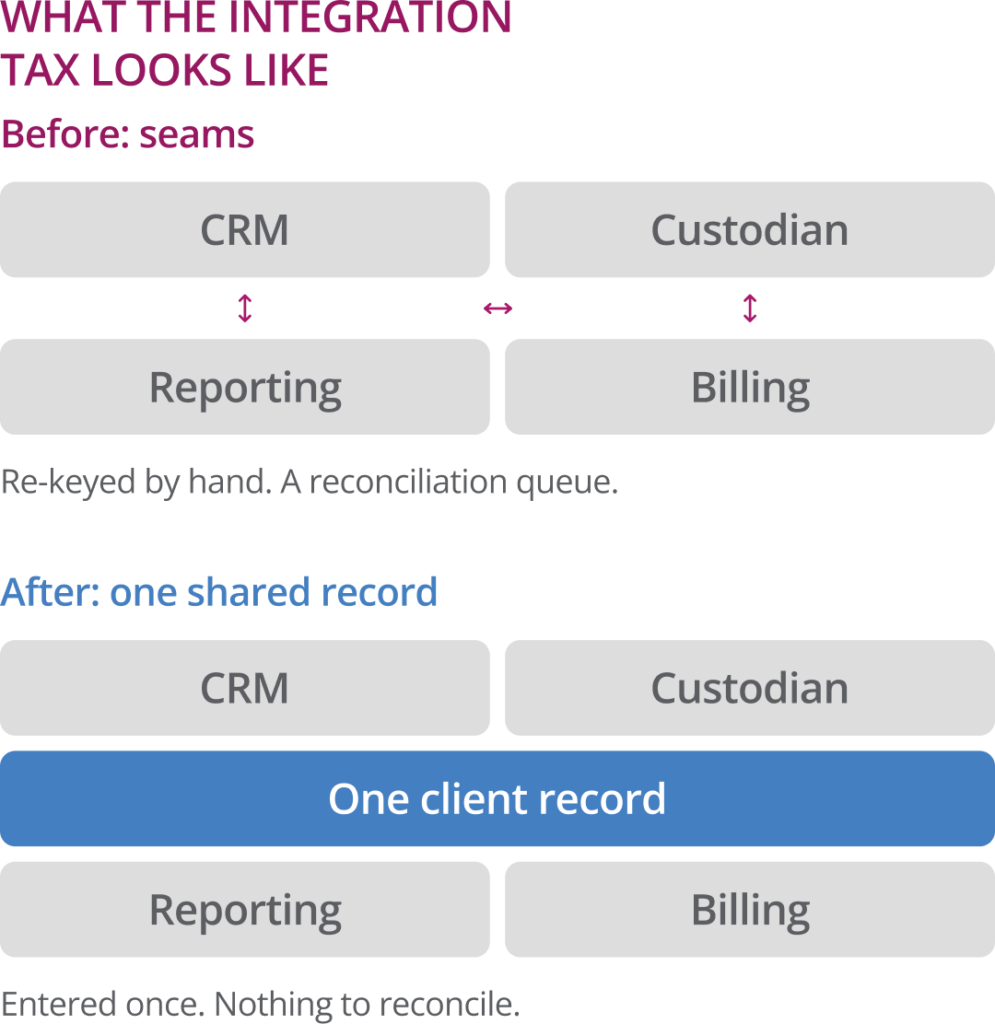
Before: seams, re-keyed by hand. After: one shared record, entered once, with nothing to reconcile.
Why this matters for your firm. Capacity spent maintaining seams is capacity not spent on growth, service, or advice. The tax compounds as you add systems, not as you add clients.
Related reading: Your Best Advisor Doesn’t Need Better Tools. They Need Their Mondays Back.
Our platform was assembled from several acquired products. Why can’t the vendor just connect it all on the back end?
Because connecting assembled systems after the fact is far harder than designing a shared foundation from the start, and some of it cannot be fully retrofitted.
When a platform grows by acquiring separate products, each one arrives with its own definitions, its own data model, and its own history. Stitching them together afterward leaves seams, and the accumulated effort of papering over them is a form of technical debt that quietly adds costs tomorrow for today’s shortcuts. The data discipline that AI rewards, one definition of each core entity enforced before applications are built, is precisely the thing that cannot be added back cleanly once the pieces already exist and already disagree.
This is why “we are modernizing our data” deserves a careful follow-up. Modernization layered on top of fragmentation does not remove the fragmentation.
Why this matters for your firm. A polished interface can sit on top of a fragmented foundation. The question is not how the platform looks. It is when and where its data was governed.
Related reading: After SaaSpocalypse: The Wealth Stacks Built Like Frankenstein Are Going to Get Eaten First
4. Why this determines enterprise value
This is where the conversation stops being about technology and starts being about the worth of your business. For most owners, it is the section that matters most.
I run a profitable firm today. Why should the state of my data change how I value my business?
Because your data foundation quietly determines three things that drive enterprise value: how efficiently you operate, how well you can grow, and whether you can safely adopt the tools that will define the next decade.
The capacity your firm spends maintaining seams and reconciling systems is capacity that never reaches a client, and that shows up directly in margin. Schwab’s RIA Benchmarking Study has found that Top Performing Firms, which more often use digital tools, workflows, and segmentation strategies, spend about 25% less time per client on operations each year than the median firm. 1 Those same firms also tend to grow faster: in the 2025 study, they saw twice the revenue growth and attracted 85% more new clients at the median than all other firms.2
- 25% less time on operations per client (Source: Schwab 2024 RIA Benchmarking Study) 1
- 2x the revenue growth (Source: Schwab 2025 RIA Benchmarking Study) 2
- 85% more new clients (Source: Schwab 2025 RIA Benchmarking Study) 2
A clean, connected foundation also lowers the risk of adopting AI, because the outputs can be trusted. The firm that has done this work can move quickly and safely. The firm that has not faces a choice between moving slowly or moving recklessly.
Why this matters for your firm. Operating leverage, growth, and AI-readiness are not three separate initiatives. They are all downstream of the same foundation.
I expect to sell or recapitalize in a few years. How does my data foundation affect what a buyer will pay?
A clean, owned, portable data foundation can directly affect the multiple a buyer is willing to pay, because it determines how much of your firm’s value actually transfers in the deal.
A sophisticated acquirer is not only buying assets under management. It is buying a business it intends to operate, integrate, and grow. If your data is clean, connected, owned by you, and portable, the acquirer can absorb the firm with confidence and little friction. If your data is fragmented, or locked inside a platform in a form you cannot fully extract, the acquirer inherits a remediation project and prices that risk into a lower offer.
On a large firm, even a modest difference in the multiple translates into substantial dollars. The same data discipline that lowers your operating costs today is the discipline that protects your valuation tomorrow.
Why this matters for your firm. Your data foundation is not only an operations decision. It is an enterprise-value decision, and it is most visible at the moment you monetize the firm.
Related reading: Why One $2B RIA Can Be Worth Double an Identical One, The Mid-Market RIA
Valuation Gap Is Widening, and RIA M&A 2026: What RIA Buyers Are Really Looking For Now
5. Why AI raises the stakes
We promised AI would come last. Here it is, exactly where it belongs: on top of everything above. Read in this order, the reason it matters is now obvious.
All right, so where does AI actually fit into all of this?
Exactly where you would now expect: on top of everything above. AI is the reason the foundation you have just read about suddenly matters more than it ever has.
AI genuinely compresses the distance between a question and a usable answer. Work that once took an analyst a week can now happen in minutes. For a service business under margin pressure, that is not a marginal improvement. It is operating leverage.
The catch is that speed is not the same as correctness. AI does not slow down when the information beneath it is wrong; it produces a confident answer either way. Everything in the previous sections, clean data, connected data, a real lake rather than a swamp, is what decides whether that confident answer is right.
Why this matters for your firm. The firms that benefit most from AI will not be the ones that adopt it first. They will be the ones whose data was in order before they did.
If AI is so powerful, why do I keep hearing it can make my firm worse, not better?
Because AI inherits the quality of the data underneath it, and it does so at speed.
AI is a tool that feeds on whatever you give it. Point it at clean, complete, well-organized information and it accelerates good decisions. Point it at fragmented or inconsistent information and it accelerates bad ones, with the same confidence and none of the hesitation a careful person would show. AI gets you to a decision much faster, but if the decision is wrong because the inputs were wrong, you have only arrived at the wrong answer sooner.
This is the real meaning of a phrase you may have heard: slow down to go fast. Get the foundation right, and AI compounds it. Skip the foundation, and AI compounds the problem.
Why this matters for your firm. Adopting AI on top of a weak data foundation does not reduce your risk. It automates and amplifies whatever is already true about your data, for better or worse.
Related reading: The RIA AI Readiness Gap: Why Infrastructure Determines Whether AI Delivers or Disappoints
6. What to do now
Where do I start? I don’t have a technical team.
Start with the decision, not the technology. Name the insight or outcome you want, then ask whether your current foundation can deliver it reliably.
You do not need to become technical to lead this well. You need to ask the right questions and refuse vague answers. Begin with one or two decisions you wish you could make with confidence today and cannot: where your organic growth is really coming from, which clients are at risk, where advisor capacity is going. Those concrete needs reveal far more about the state of your data than any vendor demonstration.
From there, treat your data as what it is: an asset of the firm, arguably a product in its own right. An asset that is governed, owned, and maintained appreciates. One that is fragmented and neglected quietly erodes value.
Why this matters for your firm. The firms that get this right tend to slow down briefly in order to move faster later. Foundation first, then AI on top, in that order.
What questions separate a real data foundation from a marketing claim?
A short list of direct questions will tell you most of what you need to know. Ask these and listen for specific answers rather than reassurance.
- Where does our data live, and do we own it, including the analytics and AI outputs built on top of it?
- If we left, what could we take with us, in what form, and would it still be usable elsewhere?
- How much cleaning happens between your raw layer and your conformed layer?
- Are your connections persistent and shared, or point-to-point integrations that move a few fields at a time?
- What single, authoritative definition do you use for a client, a household, an account, and a position?
- Show me, step by step, how raw data becomes trustworthy data in your system.
Apply these to every provider you evaluate, including us. If a vendor cannot answer them clearly and specifically, no demonstration, however impressive, should change your mind.
Where this leads
Everything above is brand-agnostic by design, because the principles are. They hold no matter whose platform you choose. They are also, simply, the conditions under which AI becomes safe and useful.
We come at this from a particular conviction: that AI readiness is an outcome of architecture, not a feature that can be purchased after the fact. If this guide helps you ask sharper questions of every provider you evaluate, including us, it has done its job.
Foundation first. Then everything else.
Appendix A: A plain-language glossary
The terms that recur throughout this guide, collected for quick reference. Defined in the context of an advisory business, not an engineering one. Share this page widely; it is the fastest way to get a whole firm speaking the same language.
Clean data
One agreed, accurate version of each fact defined the same way everywhere it appears. The opposite of several systems quietly disagreeing about the same client.
Connected data
Information that flows continuously as one shared record, rather than being passed in fragments between separate systems. Persistent, not re-stitched for every task.
Structured data
Information already organized in rows and columns, such as balances, transactions, and identifiers. Easy to sort and compute on.
Unstructured data
Information with no predefined shape, such as notes, emails, and documents. Rich in signal, harder for older systems to use, and the natural territory for AI.
Metadata
Data about data: when a record was created, by whom, from which system, and how it changed. What makes information searchable, traceable, and defensible.
Data lake
A separate store designed to hold large volumes of information over time, including history, so it can be analyzed. Distinct from the day-to-day systems where work happens.
Data swamp
What a lake becomes when inconsistent, duplicated, or undefined data is poured in without discipline. A great deal of water, none of it safe to drink.
Medallion architecture (bronze, silver, gold)
A widely adopted framework for the three stages data passes through on its way from raw (bronze) to trustworthy and conformed (silver) to business and AI-ready (gold).
Point-to-point integration
A direct link between two systems that exchanges a few specific fields on request. Functional at small scale, fragile and costly as the number of systems grows.
Seams
The gaps between systems that were never designed to work as one. Where information has to be re-keyed, reconciled, and carried across by hand.
Integration tax
The ongoing cost, in people, time, and risk, of holding those seams together. It never appears as a line item, yet you pay it every day.
Load-bearing tools
Individual applications forced to carry weight the foundation should have carried. They become fragile precisely because they were never meant to.
Technical debt
Suboptimal decisions made, related to data or technology, which accumulate cost over time to correct in the future. Cheap to incur, expensive to live with.
Single source of truth
One authoritative record for each piece of information, so every system defers to the same fact rather than maintaining its own version.
Data governance
The policies and standards that keep a data environment trustworthy over time: who may access what, how records are defined, retained, and audited.
Data portability
What you can actually take with you if you leave a platform, in what form, and whether it remains usable. A direct input to enterprise value, not a contractual detail.
Appendix B: The AI words, defined
AI comes last in this guide for a reason, but the vocabulary is worth having on hand. These are the distinctions that let you ask a vendor a sharper question than “does it have AI?”
Artificial intelligence (AI)
The broad umbrella term for systems that perform tasks normally requiring human judgment: understanding language, recognizing patterns, making decisions, generating content. Not everything labeled AI is equally sophisticated.
Machine learning (ML)
A form of AI in which a system learns patterns from data rather than following rules written by hand. The more good-quality data it sees, the better it tends to perform, which is why data quality sits upstream of everything.
Large language model (LLM)
An AI system trained on vast quantities of text to understand and generate language. Especially useful for the unstructured material, notes, emails, documents, that older systems could only store.
Generative AI
AI that creates new content (text, summaries, drafts) rather than only sorting or scoring. Powerful, and capable of producing confident output that is simply wrong, which is why governance matters.
Predictive AI
AI that forecasts an outcome from historical patterns, such as which clients are at risk or where capacity is going. Its outputs are quantitative, which makes them easier to validate than generated text.
Training versus inference
Training is how a model learns from data. Inference is the trained model producing an answer. Most firms will not train models; they will bring their own clean data to pre-trained ones. “Bringing your data” means supplying context, not building the model.
Hallucination
When a generative system produces fluent, confident content that is factually wrong. The reason a fiduciary firm pairs AI with a clean foundation and human review rather than trusting it blind.
Appendix C: A one-page diagnostic for your firm
Six honest questions, mapped to the six sections of this guide. A candid answer is worth more than a flattering one. Wherever your answer is “it depends” or “a few hours,” you have found where the foundation needs work.
- Clean data. If I asked for the complete picture of any one client, every account, asset, goal, and interaction, how long would it take to assemble, and would my systems agree with each other?
- Connected data. When a client calls, can any advisor see a complete, current view of that relationship without switching between systems or re-keying anything?
- The lake. If a provider offered to build us a data lake, could we name the specific decision it would let us make that we cannot make today?
Architecture. Are my recurring problems really about missing tools, or about tools that do not share a common foundation? How much of my team’s week goes to bridging seams by hand? - Enterprise value. If a sophisticated buyer ran diligence tomorrow, would my data be an asset that transfers cleanly, or a remediation project they price into a lower offer?
- AI readiness. If we pointed AI at our data today, would it accelerate good decisions, or
confidently accelerate the inconsistencies already in our systems?
Why this matters for your firm. Your weakest answer is your highest-priority investment. Start there, name the decision you want to make, and work backward to the foundation that would let you make it.
Appendix D: Six questions for any provider
A list of questions from Section 6 to use as a reference. Put them to every platform you evaluate, including ours. Listen for specific answers, not reassurance.
- Where does our data live, and do we own it, including the analytics and AI outputs built on top of it?
- If we left, what could we take with us, in what form, and would it still be usable elsewhere?
- How much cleaning happens between your raw layer and your conformed layer?
- Are your connections persistent and shared, or point-to-point integrations that move a few fields at a time?
- What single, authoritative definition do you use for a client, a household, an account, and a position?
- Show me, step by step, how raw data becomes trustworthy data in your system.
Sources
- Charles Schwab, 2024 RIA Benchmarking Study. Top Performing Firms (the top 20% of the study’s Firm Performance Index), which more often use digital tools and workflows, spent around 25% less time annually per client on operations and about 10% more time per client on client service than the median firm. Based on self-reported data from 1,304 firms.
- Charles Schwab, 2025 RIA Benchmarking Study. Top Performing Firms saw roughly twice the
revenue growth and attracted 85% more new clients at the median than all other firms. Based
on self-reported data from 1,288 participating firms.
Disclosure
This white paper was produced and published by Amplify Technology, LLC (“Amplify”). The authors are members of the Amplify leadership team, and the content reflects their personal views and industry observations. It is provided for informational and educational purposes only. The principles described apply to any firm’s data foundation, regardless of the platform a firm chooses.
It does not constitute investment, legal, tax, accounting, or M&A advisory advice, nor does it constitute a recommendation regarding any specific firm, transaction, or operational decision. Valuation outcomes vary significantly based on firm-specific factors not addressed herein. Industry data and transaction examples cited reflect historical activity and are not predictive of future outcomes for any specific firm. Readers considering decisions related to firm valuation, sale, or operational strategy should consult qualified investment banking, legal, tax, and advisory professionals.
Amplify Technology, LLC (“Amplify”) is not a registered investment adviser. Its services are for informational purposes only and do not constitute investment advice or a recommendation. Please consult a registered investment adviser before using Amplify and its services.

Contact Us
Have a question?
To learn more about the Amplify Platform and how Amplify can simplify your journey with modern technology that works for you, reach out to connect with our experts today.